
How to Design Swing Gates for Sloped Driveways in Melbourne

Designing swing gates for sloped driveways is often challenging for Melbourne homeowners and builders. With varied terrain across inner suburbs, driveway gradients significantly affect how a swing gate looks, moves, and performs over time. A gate that works on level ground may scrape, bind, or fail when installed on a slope if it’s not designed correctly.
This guide covers everything you need to know about designing a swing gate on a slope in Melbourne, from assessing gradients and choosing the right gate style to hinge selection, automation tips, and local compliance considerations. We’ll walk through the practical and design-focused decisions that lead to smooth, reliable results.
Understanding Sloped Driveway Challenges for Swing Gates
Sloped driveways introduce both mechanical and visual challenges. Before choosing a gate design, it’s essential to understand how these factors interact.
Ground clearance vs aesthetics
One of the biggest design tensions is achieving sufficient ground clearance for the gate to open freely without creating a gap beneath it. Too little clearance and the gate may strike the driveway; too much and the entrance can look unfinished or compromise privacy. On sloped sites, this balance is even more critical, especially for front-facing driveways.
Safety and compliance considerations
Swing gates must operate safely regardless of driveway conditions. On a slope, gravity can increase closing forces, and uneven clearances can create pinch points. For automated systems, proper force settings, obstacle detection, and hinge geometry are essential to comply with Australian safety standards.
Common issues builders face on Melbourne sites
Across Melbourne, builders often encounter sloping driveways resulting from block falls or heritage streetscapes with established road levels. Common issues include insufficient gate-swing clearance, misaligned hinge posts due to uneven footings, and late-stage driveway changes.
Assessing the Slope Before Gate Design
A successful swing gate on a slope starts with an accurate site assessment. Guesswork at this stage often leads to costly adjustments later.
Measuring the gradient and fall accurately
Measuring the driveway gradient involves more than noting that it “slopes up” or “slopes down.” It is about precise measurements of total fall across the gate opening, as well as the fall over the gate swing arc. Even small changes in height can affect clearance when the gate opens through its full range.
Cross fall vs straight slope considerations
Not all slopes are straightforward. Some driveways slope directly away from the street, while others have cross fall, where the driveway slopes sideways. Cross fall can be more challenging for swing gates, as each leaf may experience a different clearance profile during opening and closing.
How driveway materials affect gate movement
Concrete, asphalt, and paved driveways all behave differently over time. Pavers may settle unevenly, while asphalt can deform slightly in hot weather. These factors should be considered during design to enable future movement without causing gate strikes or misalignment.
Swing Gate Design Options for Sloped Driveways
Choosing the right gate style is important for sloped installations. Certain designs naturally perform better on uneven ground.
Raked (Rising) Swing Gates
Raked swing gates are designed to accommodate slopes by following the angle of the driveway. A raked gate has a bottom edge that slopes upward to match the driveway grade. As the gate opens, it maintains a consistent clearance from the ground, reducing the risk of contact.
Raked gates provide excellent functionality on moderate slopes and maintain a cohesive look. However, they require precise fabrication and may not suit all architectural styles, particularly where strict symmetry is desired.

Split or Stepped Gate Designs
For steeper slopes, split or stepped designs can be a practical alternative. Stepped gates divide the gate leaf into sections with different ground clearances. While functional, they can appear more utilitarian if not carefully detailed. Therefore, thoughtful design is crucial for front-facing properties.
Stepped designs are often ideal for long or steep driveways where a single raked line would result in excessive gaps or awkward proportions. They’re commonly used on side driveways that prioritise function over form.

Hinge Options for a Swing Gate on a Slope
Hinges play a critical role in how a swing gate behaves on a slope. The wrong hinge choice can undermine even the best gate design.
Adjustable Offset Hinges
Adjustable offset hinges allow fine-tuning after installation, which is invaluable on uneven sites. These hinges enable installers to adjust the gate's height, angle, and offset to ensure consistent clearance. This flexibility is particularly useful when driveway levels change after installation.
Rising Hinges
Rising hinges are designed to lift the gate leaf as it opens, increasing ground clearance.
Allowing gates to lift as they open: As the gate swings inward, the rising hinge mechanism raises the gate, preventing it from scraping the driveway. This solution works well for inward-opening gates on sloping sites.
Load limits and durability: Select rising hinges carefully based on the gate's weight and width. Heavier steel gates require high-quality, load-rated hinges to ensure long-term reliability.
Heavy-Duty Hinges for Wide Gates
Wide driveway openings place additional stress on hinges, especially on slopes. For large or heavy swing gates, heavy-duty hinges with reinforced posts and footings are essential. Proper structural planning helps prevent sagging, uneven movement, and premature wear.
Automation Tips for a Swing Gate on a Slope
Automating a swing gate on a sloped driveway requires more than adding a motor. The slope changes how forces act on the system.
Choosing the Right Gate Motor
Not all gate motors perform equally well on sloped installations.
Linear vs articulated arms: Linear motors are compact and suited to many residential gates. But articulated arms often perform better on sloped or restricted openings due to their flexible movement path.
Force and torque requirements: Slopes increase the effort required to open and control the gate. Motors must be correctly sized to handle additional load without exceeding their limits.
Motor Placement on Sloped Driveways
Incorrect motor placement is a common cause of automation issues. Motors must be positioned to avoid contact with the driveway during operation. On sloped sites, careful geometry planning prevents overextension and uneven wear.
Safety Accessories for Automated Gates
Safety is non-negotiable for automated swing gates.
Photoelectric sensors: Photoelectric beams detect vehicles or pedestrians in the gate path. They’re particularly important on sloped driveways where visibility may be limited.
Soft start/stop and obstacle detection: Modern automation systems with soft start/stop features reduce mechanical stress, while obstacle detection adds an extra layer of safety for families and visitors.

Materials That Perform Best on Sloped Installations
Material choice affects how a swing gate on a slope performs, both structurally and visually.
Steel vs aluminium weight considerations
Steel gates offer strength and security but are heavier, placing more load on hinges and motors. Aluminium gates are lighter, making them ideal for sloped installations. The reduced weight improves longevity and performance.
Wind loading on elevated gates
On sloped driveways, parts of the gate may sit higher off the ground, increasing exposure to wind. Slatted or perforated designs help reduce wind loading while maintaining privacy.
Long-term maintenance factors
Materials should be chosen with maintenance in mind. Powder-coated aluminium and galvanised steel are popular in Melbourne for their weather resistance and minimal maintenance requirements.
Local Melbourne Compliance and Practical Build Tips
Beyond design and mechanics, local considerations play a big role in successful gate installations.
Council and boundary considerations: Melbourne councils have varying rules on setbacks, boundary lines, and gate swing directions. Early checks help avoid compliance issues, especially in heritage overlays or narrow streets.
Drainage and water runoff impacts: Sloped driveways often direct water toward the gate opening. Proper drainage design prevents water pooling around hinge posts and motors.
Allowances for driveway resurfacing: Driveways are often resurfaced years after a gate is installed. Allowing extra clearance and adjustability ensures the gate continues to operate after future works.
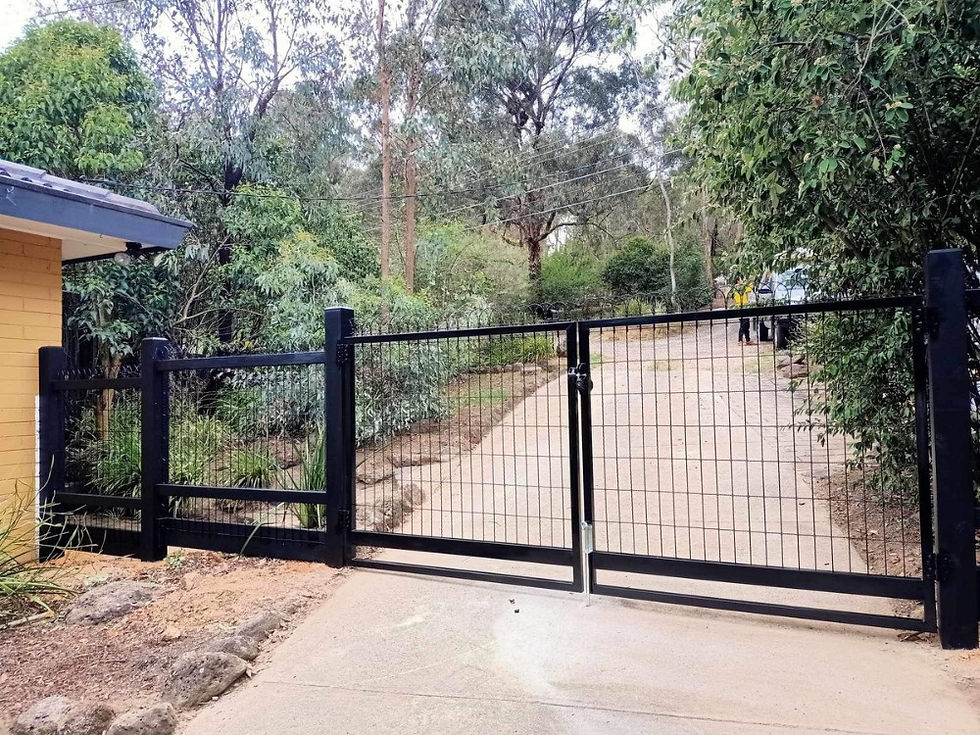
How LATITUDE Designs Swing Gates for Sloped Driveways
At LATITUDE Fencing & Gates, sloped driveways are treated as a design opportunity, not a limitation. Our approach combines technical precision with practical construction knowledge.
Builder-friendly design collaboration: We work closely with builders, designers, and homeowners early in the process to ensure gate designs align with site conditions, construction timelines, and future plans.
Custom hinge and automation solutions: Every sloped driveway is different. That’s why we specify custom hinge configurations and automation systems tailored to the exact gradient, gate weight, and usage requirements.
On-site assessment and precision installation: Our on-site assessments ensure accurate measurements and real-world planning before fabrication begins. Precision installation ensures smooth operation, safety compliance, and a polished finish.
In Conclusion
Designing swing gates for sloped driveways in Melbourne requires careful planning and a deep understanding of how slopes affect movement, safety, and aesthetics. From assessing gradients and selecting suitable gate designs to selecting hinges and automation systems, every decision affects long-term performance.
If you’re planning a swing gate on a slope, working with specialists who understand Melbourne conditions makes all the difference. Contact LATITUDE for a free on-site consultation and discover how a custom-designed swing gate can work seamlessly with your driveway, no matter the slope.
Frequently Asked Questions
1. Can swing gates work on steep driveways in Melbourne?
Yes, swing gates can work well on steep driveways when they are designed for the slope. Solutions such as raked gate designs, stepped gate leaves, rising hinges, or inward-opening configurations help maintain safe clearance and smooth operation. Also, accurate site measurements and custom fabrication are essential.
2. Are automated swing gates safe to use on sloped driveways?
Automated swing gates are safe on sloped driveways when the correct motor type, force settings, and safety accessories are used. Features like photoelectric safety beams, obstacle detection, and soft start/stop functions are particularly important on slopes.
3. Should the gate be designed before or after the driveway is finished?
Ideally, swing gates should be designed after the final driveway levels are known. Changes in driveway height, surface materials, or drainage can affect gate clearance and hinge alignment. If the driveway isn’t complete yet, experienced installers can account for future adjustments. But final measurements always yield the best long-term results.


Comments