
How Driveway Gates Improve Home Security Beyond the Front Door

Home security is often associated with front door locks, alarm systems and cameras installed around the house. However, driveway gate security moves the first point of control to the property boundary. It allows homeowners to manage visitors before anyone reaches the house, garage or side pathways.
On the other hand, a driveway gate is not a complete security system by itself. Its effectiveness depends on the gate design, the surrounding fence, and automation equipment. When these elements are planned together, the entrance can provide greater privacy and a safer environment for everyday family life.
Driveway Gate Security Creates the First Physical Layer of Protection
Residential security works best when it includes several layers rather than relying on a single lock, alarm or camera. The front door remains an important barrier, but installing a driveway gate shifts the first physical checkpoint farther from the house.
A closed gate establishes a clear separation between the public street and private property. It communicates that access is controlled and that visitors should request permission before entering. This can discourage casual trespassing, unauthorised parking and people approaching the home without a clear reason.
A substantial gate can also influence how easily accessible a property appears. An open driveway may allow someone to walk or drive directly towards the garage, front door or side access. A closed gate introduces an additional step before continuing.
The gate should be designed as part of the complete front boundary. Gaps beside the gate, low fencing, and unsecured pedestrian openings can weaken the overall security of the entrance. Gate height, fence height, spacing and adjoining landscaping should therefore be considered together.
Common driveway gate configurations include:
Sliding gates for sites with limited inward swing space
Swing gates for wider or more traditional entrances
Telescopic sliding gates for properties with limited side return
Bi-fold swing gates where a smaller swing area or faster movement is preferred
The most suitable configuration depends on the driveway width, ground slope, available opening space and household traffic. A well-designed gate should create a strong boundary without making daily entry unnecessarily difficult.

Controlled Access Helps Homeowners Decide Who Enters
One of the strongest benefits of a driveway gate is the ability to control entry. Instead of reacting to an unexpected visitor at the front door, residents can assess the person while the visitor remains at the property boundary.
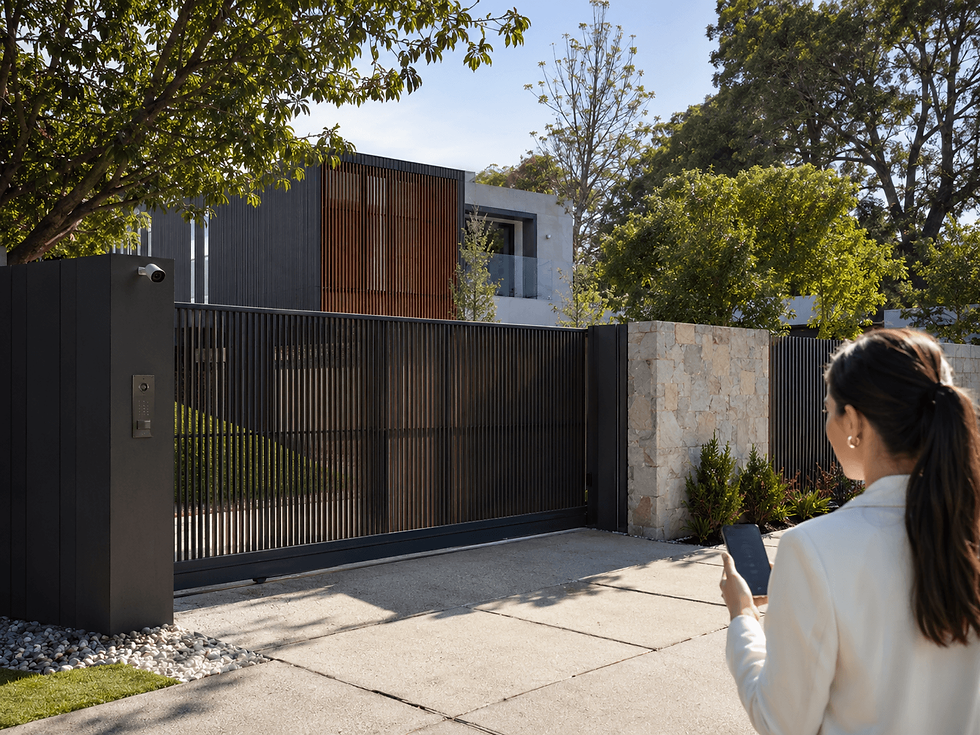
An automated gate can remain closed throughout the day while approved users enter via remote controls, keypads, or smartphone applications. This allows residents to maintain a defined boundary without having to manually open and close the gate each time they leave or return.
Intercom systems provide an additional level of verification. Homeowners can speak with guests before deciding whether to open the entrance. A video intercom shows the visitor, their vehicle and activity around the gate.
Modern access systems can also assign different permissions to different users. Family members may have permanent access, while cleaners, carers, gardeners or regular service providers receive scheduled permissions or temporary PIN codes. This reduces the need to distribute physical remotes.
Effective home entrance security should remain practical. A complicated system that residents frequently bypass or leave open may offer less protection than a straightforward system used consistently every day.
A Driveway Gate Can Deter Unwanted Vehicles and Opportunistic Entry
Vehicles, garages, tools, bicycles, outdoor equipment and side access areas may all be exposed before an intruder reaches a locked door.
An open driveway can allow unknown vehicles to enter, turn around or park temporarily without permission. It may also provide a direct approach to the garage or carport. A closed automated gate sends a clearer message that vehicle entry is controlled.
However, deterrence does not mean a gate is impossible to bypass. Instead, the gate increases the time, effort, and visibility required to enter the property. Opportunistic intruders often seek convenient access, so even a well-controlled entrance may prompt them to move on.
Material and design choices also influence how the entrance performs. Aluminium, steel, timber, wrought iron, PVC and Colorbond can each provide a different combination of structural presence, durability, screening and visual style.
A fully private gate can prevent people from seeing into the driveway, but it may also reduce passive surveillance from neighbours and the street. An open or semi-private design allows greater visibility around the entrance.

Smart Technology Extends Protection Beyond the Gate Structure
Modern residential entrances combine gate automation with connected security and access technologies. Rather than relying only on a motor and remote control, homeowners can create an integrated system that supports verification, monitoring and access management.
CCTV cameras can be positioned to record vehicles, visitors and activity around the front boundary. Camera effectiveness depends heavily on placement, image quality, lighting and viewing angle. A camera positioned too high, facing direct sunlight or obstructed by landscaping may capture less useful footage than expected.
Smart app control allows residents to check whether the gate is open or closed, operate it remotely, and manage user access while away from home. This can be useful when allowing a trusted tradesperson, family member or delivery driver to enter without handing over a permanent remote.
Video intercom integration allows residents to receive visitor calls on an indoor monitor or smartphone. They can see and speak with the visitor before releasing the gate.
Additional smart features may include:
Smart locks for pedestrian gates
Voice assistant integration
Entry and exit notifications
Timed access schedules
Temporary visitor credentials
CCTV event recording
Gate-open alerts
Remote access should still be used carefully. Residents should verify who is requesting entry rather than automatically opening the gate in response to every delivery message or intercom call.
Technology provides the most value when it makes access easier to verify and manage without encouraging residents to compromise secure routines.

Driveway Gates Can Improve Safety and Privacy for Families
The benefits of a driveway gate extend beyond protection from intrusion. A closed boundary can also help families create a more controlled environment for children, pets, and daily activities at the front of the home.
A driveway gate may reduce the likelihood of young children or pets moving directly from the driveway onto the road. However, it should never replace active supervision or a compliant pet, boundary or swimming pool barrier where one is legally required.
Gates can also reduce uninvited approaches to the house. Residents may feel more comfortable using the front garden or working in the garage when casual visitors cannot walk directly to the front door.
Automation adds practical convenience, particularly when arriving home alone, at night or during poor weather. Residents can enter without leaving the vehicle to manually open a heavy gate. Appropriate driveway lighting, clear intercom visibility and well-positioned cameras can further improve confidence when entering after dark.
Safety features are an essential part of any automated entrance. Depending on the gate system and site conditions, these may include photocells, obstacle detection, safety edges, controlled operating forces and emergency release arrangements.
The entrance should also be planned around real household traffic. School drop-offs, multiple vehicles, bicycles, prams, visitors, and parcel deliveries can all affect when and how long the gate should open.
A secure gate should support everyday routines rather than becoming an obstacle that residents are tempted to disable or leave open.

Why Professional Gate Design and Installation Matter
Placing a large gate across a driveway does not automatically create a reliable entrance. The structure must suit the property, connect correctly to the fence, and operate consistently under real-world site conditions.
A professional assessment should consider the driveway gate width, slope, ground conditions, gate travel, vehicle turning movements, wind exposure, nearby landscaping and existing underground or overhead services. These factors influence the gate style, dimensions, frame strength and automation requirements.
Posts, foundations, tracks, hinges and gate frames must also be correctly engineered and aligned. A poorly installed gate may drag along the ground, move unevenly, or place excessive pressure on the motor.
Material selection should balance the desired level of screening with the home’s architectural style. Options may include aluminium slats, vertical battens, tubular steel, timber, PVC, Colorbond, wrought iron or customised combinations.
The front fence, driveway gate, pedestrian gate, automation, intercom, CCTV, and smart controls should ideally be treated as a single, connected entrance. Planning each component separately may create inconsistent finishes, awkward access points or gaps in coverage.
Professional commissioning should include testing the gate motor, opening and closing positions, and access devices. Homeowners should also be shown how to operate the system and what to do if power or automation fails.
At LATITUDE Fencing & Gates, the process of driveway gate security begins with a consultation. Once the site and requirements are understood, a design or sketch can be prepared where required, followed by a detailed quotation. After acceptance, the installation is scheduled, completed and supported through after-completion assistance for workmanship-related concerns.
Professional planning helps ensure the entrance remains secure, convenient and dependable for years to come.
Contact us today to arrange an obligation-free consultation and create a secure, convenient and professionally designed entrance for your home.

Frequently Asked Questions
Do driveway gates actually improve home security?
They create an additional physical and psychological barrier, limit unrestricted vehicle access and allow visitors to be screened before reaching the house. Their effectiveness improves when they are connected to suitable fencing, automation, intercoms, lighting and CCTV.
Is a sliding gate more secure than a swing gate?
Both styles can provide strong protection when they are correctly designed and installed. The best choice depends on the available side space, driveway slope, opening width, wind exposure and normal vehicle movements.
Should a driveway gate be fully private?
A fully private gate can reduce views into the property, while an open or semi-private design may improve visibility and passive surveillance. The right balance depends on the streetscape, property layout and the level of privacy the homeowner wants.
Can I control my driveway gate from my phone?
Compatible automation can connect with mobile applications, video intercoms and access management systems. Reliable power, internet coverage, secure user accounts and correct installation are important for dependable remote operation.
What happens during a power outage?
Automated gates generally include a manual emergency release, while some systems can also support optional battery backup. Residents should understand how to use the release and ensure that unauthorised people cannot easily access it.


Comments