
Privacy Front Fence Options for Glen Iris Homes Near Main Roads

Key Takeaways
Best for privacy and noise control: a solid masonry wall or purpose-designed modular acoustic wall.
Best contemporary compromise: solid wall sections combined with carefully positioned aluminium slats.
Best mainly for visual privacy: aluminium blades, battens or closely spaced slats.
Practical low-maintenance option: solid steel or Colorbond-style panels where appropriate to the property.
Remember: gaps below panels, open gates and driveway openings can significantly reduce acoustic performance.
Living near a busy road in Glen Iris can make the front of your property feel more exposed than you would like. Traffic noise can affect how comfortable your front garden and street-facing rooms feel. Choosing a privacy front fence Glen Iris homeowners can rely on therefore needs to balance visual privacy, traffic-noise control, driveway access, local streetscape character and council requirements.
Why Homes Near Glen Iris Main Roads Need a Different Front Fence Strategy
Front fencing beside a quieter residential street can focus on boundary definition, architecture and security. Meanwhile, a home exposed to heavier traffic has additional issues to solve, including noise, moving vehicles, headlights and frequent pedestrians.
Constant Traffic Creates Both Visual and Acoustic Exposure
Road traffic affects different properties in different ways. Traffic volume, vehicle type, road speed, road gradient and distance from the road can all influence the amount of noise reaching a home.
A property near an intersection may experience braking, acceleration and buses stopping nearby, while a home on a through-road may experience a more continuous background sound.
A Privacy Fence Is Not Automatically a Noise Barrier
A closely spaced aluminium slat fence can make a front yard feel much more private because people passing on the footpath cannot easily see inside. However, gaps between the slats still provide paths for sound.
By comparison, a continuous wall with sealed joints and minimal openings has characteristics better suited to controlling traffic noise. This is why homeowners should decide early whether the main objective is preventing overlooking, reducing road noise or achieving both.
Glen Iris Streetscape Character Still Matters
Noise exposure does not mean a very high solid wall is the best answer. Glen Iris includes established gardens, older homes, renovated properties and contemporary architecture. Fence proportions, materials and transparency can affect how the frontage relates to the house and surrounding street.
Victoria's urban-design guidance encourages fencing to respond to neighbourhood character and recognises the benefits of lower or partially transparent fencing for maintaining passive surveillance of the street.
The objective is therefore to position stronger screening where it provides the most benefit without unnecessarily turning the entire property frontage into a solid wall.

Four Privacy Front Fence Glen Iris Options for Homes Near Busy Roads
There is no single material that suits every property. Architecture, frontage width, road exposure, driveway position and the level of privacy required should all influence the final design. For homes near main roads, these four options are particularly worth considering.
Modular Acoustic Walls With Aluminium Slat Inserts
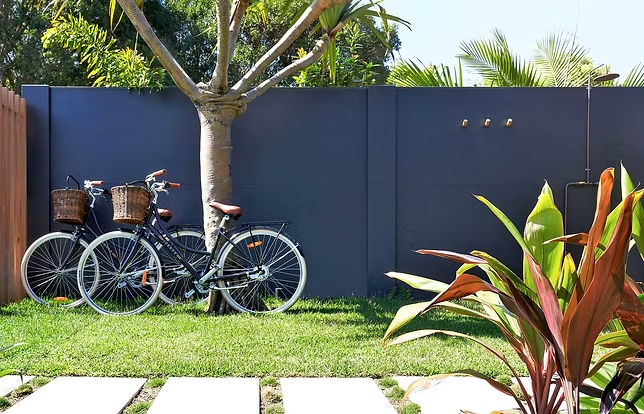
Modular wall systems can provide the clean appearance of a rendered wall without relying on traditional brick or block construction.
A solid modular wall can provide strong visual screening and can work well with contemporary renovations and modern Glen Iris homes. Depending on the design, it can also integrate with masonry-style piers, pedestrian gates and automated driveway gates.
Where noise reduction is a priority, homeowners should choose a purpose-designed and tested acoustic system rather than assuming every modular panel provides the same performance.
Aluminium slat inserts can also be incorporated into selected areas to reduce the visual weight of the wall, introduce architectural detail or maintain some openness. However, every open section reduces the continuity of the acoustic barrier. Slats should therefore be positioned strategically rather than added across the entire frontage.
Solid Brick, Block or Rendered Masonry Walls
Brick, concrete block and rendered masonry walls provide excellent visual privacy and can complement both traditional brick homes and contemporary rendered architecture. Their mass also makes them suitable for projects where traffic-noise reduction is a significant consideration.
VicRoads identifies materials including brick and concrete blocks as having very good sound-reducing properties. It also explains, however, that the performance of the barrier depends on factors beyond material alone, including height, continuity and sound travelling over or around the wall.
Masonry also requires appropriate footings and structural construction. Higher walls may trigger building or planning approval requirements, so these should be investigated before the design is finalised.

Aluminium Blade and Slat Front Fencing
Aluminium is particularly useful where visual privacy is more important than maximum acoustic performance. Options include:
horizontal aluminium slats;
vertical battens;
angled privacy blades; and
combinations of aluminium panels with masonry or rendered piers.
The slat fencing spacing and orientation can be adjusted to control views into the property while retaining airflow and a lighter street presence. Powder-coated aluminium is also low maintenance and works well with many contemporary Melbourne homes.
For road-noise reduction, however, aluminium slats generally rank below a well-constructed continuous wall. Openings between the blades allow sound to pass through, even when the fence looks relatively private from the street.

Colorbond and Solid Steel Panel Fencing
Solid steel panels can provide excellent sightline blocking, durability and relatively simple maintenance. They may suit situations where homeowners want an uncomplicated solid screen without the heavier construction associated with masonry.
The design should still be considered in relation to the home's architecture and surrounding streetscape, particularly on prominent Glen Iris frontages.
Standard Colorbond fencing should also not automatically be described as an acoustic fence. If measurable noise performance is required, use a system with documented acoustic properties rather than assuming that any solid steel panel will deliver significant sound reduction.

What Actually Makes a Front Fence Reduce Traffic Noise?
Choosing a dense material is only one part of acoustic fence design. Barrier height, its position relative to the road and home, and the number of openings can significantly affect the result.
Height and Line of Sight
One of the main functions of an acoustic barrier is to interrupt the direct path between the traffic and the area you are trying to protect. An effective traffic-noise barrier should block the line of sight between the noise source and receiver.
However, that does not mean homeowners should simply make the fence as high as possible. Planning, building and streetscape controls still determine what can reasonably be constructed.
Density, Continuity and Gaps
Sound can travel through gaps, underneath a fence and around its ends. For a more effective barrier, consider:
tight panel joints;
minimal openings beneath the fence;
well-designed connections to posts and piers;
returns at appropriate locations; and
sufficient material density for the intended application.
VicRoads advises that barriers should contain few, if any, holes, cracks or openings. Its guidance indicates that a properly designed suburban barrier may achieve approximately 5–10 dB(A) reduction in outdoor traffic noise in suitable circumstances. This is more realistic than describing a front fence as completely “soundproof”.
Gates Can Become the Weak Point
A continuous wall cannot remain completely uninterrupted when a property needs pedestrian and vehicle access.
Pedestrian gates can often be designed with solid infill panels that continue much of the fence's screening. Meanwhile, driveway gates are more complicated because they require operational clearances and a large opening whenever the gate is open.
For a privacy front fence Glen Iris project where noise matters, the fence and gates should therefore be designed as one coordinated frontage rather than treating the driveway gate as an afterthought.

Front Fence Permits in Glen Iris: Stonnington vs Boroondara
Before choosing a fence height or construction method, confirm which council controls apply to your address. Glen Iris does not sit entirely within one municipality, and planning requirements can vary according to location, road classification, overlays and fence materials.
First Confirm Which Council Covers the Property
Glen Iris extends across both the City of Stonnington and City of Boroondara. The relevant council should therefore be confirmed using the property's actual address rather than assuming one set of requirements applies throughout the suburb.
Stonnington Front Fence Requirements
Building permits and planning permits are different approvals and should not be treated as interchangeable.
Stonnington states that a building permit is required for a masonry, concrete or similar street fence higher than 1.2 metres. For lightweight fencing, including timber or Colorbond, its building guidance generally identifies 1.5 metres as the relevant threshold.
Separately, Stonnington's residential planning guidance indicates that a planning permit may be required for a front fence within three metres of the street where its height exceeds:
2 metres on a main road; or
1.5 metres on a side street.
Importantly, the 2-metre planning threshold for a main road does not mean that every fence up to two metres can automatically be constructed without approval. Building-permit thresholds, overlays and other requirements still need to be checked.
Boroondara Requirements
Boroondara similarly identifies building-permit triggers for front fences higher than:
1.2 metres for masonry fences; and
1.5 metres for non-masonry fences.
Boroondara also distinguishes properties adjoining declared roads when considering taller front fences and Report and Consent requirements.
Before approving the final design, homeowners should also check whether Heritage, Significant Landscape or other planning overlays affect the property.
Permit summary: Do not select a fence height based only on whether your property is on a main road. First confirm the council, fence material, building-permit requirements, planning controls, road classification and applicable overlays.

Maintaining Driveway Sightlines Without Giving Up Privacy
A front fence should make the property more comfortable without creating unnecessary visibility problems when vehicles leave the driveway. Privacy fencing, gate posts, masonry piers and landscaping should all be reviewed together when considering sightlines.
Do Not Design Privacy in Isolation From Vehicle Access
Extending the tallest solid section of a fence directly across every part of the frontage may not always be appropriate. The design should account for:
pedestrians approaching along the footpath;
vehicles entering or reversing from the driveway;
neighbouring driveways;
gate posts and masonry piers; and
shrubs or hedges that may obstruct the same sightlines as the fence.
Boroondara specifically identifies additional requirements for corner fences within nine metres of an intersection, including a building-permit trigger where fencing exceeds one metre in relevant circumstances.
Integrate the Gate Into the Privacy Design
Good privacy design does not necessarily require maximum screening across every metre of frontage. Depending on the site, practical solutions can include:
visually permeable sections beside the driveway;
angled screening;
setting a driveway gate back where appropriate;
keeping vegetation lower near the vehicle exit; and
concentrating solid acoustic fencing around the outdoor areas or rooms most affected by the road.
For properties within Stonnington, council guidance also states that gates must not swing beyond the title boundary over the footpath or road reserve.

Choosing the Right Front Fence for Your Glen Iris Property
The best frontage is usually the result of understanding the site before deciding on a particular material. Consider what you actually need the fence to achieve and which areas of the property deserve the greatest protection.
Before requesting a design or quotation, ask:
Where does most of the noise come from? General traffic, buses, trucks or an intersection?
Which areas need protection? The front garden, bedrooms, living areas or the entire frontage?
Is privacy or acoustic improvement the greater priority?
What height is realistically approvable?
Is the property within Stonnington or Boroondara?
Are any planning overlays involved?
How will pedestrian and driveway gates interrupt the fence?
Which materials best complement the home's architecture?
LATITUDE Fencing & Gates can assess the frontage, discuss the level of screening required and develop a coordinated solution incorporating fencing, modular or masonry-style sections, pedestrian access and driveway gates.
Planning a privacy front fence Glen Iris property owners can enjoy long term also means checking the correct council requirements before construction begins.
Talk to LATITUDE Fencing & Gates about your Glen Iris frontage. We can assess your site, discuss privacy and access requirements, recommend suitable fencing materials, and coordinate pedestrian and driveway gates as part of one customised solution. Contact us today for an obligation-free consultation and quotation.
FAQs
What is the best fence for reducing road noise in Glen Iris?
A continuous solid masonry wall or a purpose-designed acoustic modular wall will generally be more appropriate than an open slat fence when road-noise reduction is a primary objective. The final result still depends on height, position, continuity and openings.
Will aluminium slat fencing reduce traffic noise?
Aluminium slats can provide excellent visual privacy, particularly when blades are closely spaced or angled. However, gaps between the slats allow sound to travel through, so they will be less effective than a properly designed solid barrier.
Can I build a 2-metre front fence on a Glen Iris main road?
Potentially, but you should not assume that a two-metre fence is permit-free. Building-permit thresholds differ according to construction materials, while planning controls, road classifications and overlays may introduce additional requirements.
Is Colorbond suitable for a Glen Iris front fence?
It can provide strong visual privacy, durability and relatively low maintenance. However, consider whether the appearance suits the home and surrounding streetscape.
Can a privacy fence include an automatic driveway gate?
Yes. In fact, designing the automatic driveway gate and fence together is preferable. It allows privacy, driveway visibility, gate movement, pedestrian safety, access control and the overall architectural appearance to be considered as one coordinated frontage.


Comments