
Wide Driveway Gate Design for Caravans, Trailers and Delivery Vehicles

Key Takeaways:
Start with the largest vehicle that will regularly use the property, then assess the true clear gate opening, street approach, crossover alignment and complete vehicle swept path.
Allow room for the trailer to track inside the tow vehicle's turn and for the driver to make steering corrections without approaching posts too closely.
Check combination length, driveway setback and overhead clearance as well.
Select the gate system - sliding, swing, telescopic or bi-fold - according to the available side space, driveway depth and actual vehicle movement.
A driveway entrance that works perfectly for the family car can become much harder to use when you add a caravan, boat trailer, trades trailer or delivery vehicle. Planning a wide driveway gate therefore involves more than adding a small amount of clearance. The key principle is simple: design the entrance around the largest vehicle you realistically expect to use, not only the vehicle currently parked in the garage.

How Should You Design a Wide Driveway Gate for Caravans, Trailers and Larger Vehicles?
Start by looking at the complete vehicle movement rather than the gate in isolation. A generous-looking driveway opening can still be awkward if a caravan approaches from a narrow street, or the trailer cuts inward during the turn.
The most practical driveway gate design comes from matching the entrance to the vehicle, its approach path and the space available before and after the gate.
Start With the Largest Vehicle That Needs Regular Access
First establish your design vehicle: the largest vehicle or combination the entrance needs to accommodate regularly.
For one household, this may be a caravan connected to a large ute. Another property might need to accommodate a boat trailer, camper trailer, motorhome or trades trailer. Some homeowners also want occasional access for furniture removal vans, landscaping vehicles or larger delivery vehicles.
Where possible, measure the actual vehicle instead of relying on a generic category.
Width is only the starting point. You also need to understand its overall length, tow vehicle length, trailer or caravan length, drawbar length, mirrors, projecting accessories, vehicle height, wheelbase and axle position.
Length becomes particularly important once commercial vehicles are involved. For context, the NHVR lists a general-access rigid truck at up to 12.5 metres long and 2.5 metres wide, while some general-access truck-and-trailer combinations can reach 20 metres in overall length.

Calculate the Clear Gate Opening, Not Just the Driveway Width
A common mistake is measuring the general width of the driveway rather than the opening that will actually remain once the gate is installed. The useful dimension is the clear opening between the closest fixed obstructions when the gate is fully open.
Posts, brick piers, hinges, gate stops, automation hardware, sliding-gate guides, photocells, retaining walls, landscaping and access-control equipment can all reduce usable space.
For example, a caravan that measures 2.5 metres across should not automatically lead to a 2.5-metre gate opening. That would provide virtually no tolerance for its approach angle, steering correction or trailer movement.
For this reason, LATITUDE generally recommends determining the required clear opening after the vehicle dimensions and practical entry route have been considered together rather than relying on a universal minimum.

Check the Vehicle's Turning and Swept Path
When you turn through a gate, different parts of the vehicle follow different paths.
The tow vehicle's front corner may move outward while its rear wheels follow a tighter curve. The caravan or trailer then tracks inside the tow vehicle's path, while long rear overhangs may move laterally in another direction.
A driver can therefore clear the first gate post comfortably with the tow vehicle and still bring the caravan uncomfortably close to the opposite post.
When planning the entrance, consider the width of the street, distance to the opposite kerb, crossover position, gate-post locations, fence alignment, nearby parked vehicles, trees, utility poles and whether the caravan will normally be driven or reversed into the property.
This is why a wide driveway gate should be assessed as part of the complete turning manoeuvre. Adding several hundred millimetres to the opening may help, but changing the gate position, widening the crossover where permitted or improving the approach angle can sometimes make a much greater difference.

Consider the Tow Vehicle and Trailer as One Combination
A caravan entrance also needs sufficient length, not just width. Imagine approaching an automatic gate with a large SUV towing a caravan. The vehicle must leave the traffic lane, cross the footpath, approach the entrance and potentially stop while the gate completes its opening cycle.
If the gate is too close to the street, the entire combination may not fit between the roadway and the closed gate.
That can leave part of the caravan, trailer or tow vehicle extending across the footpath or into the street while the driver waits. It can also make reversing or correcting the vehicle considerably more stressful.
Setback should therefore be considered alongside gate opening width, particularly where long vehicles regularly use the property.
Body overhang matters as well. A rear corner can swing sideways during a turn even when the wheels themselves appear well clear of an obstruction. The gate design should account for both wheel position and the extremities of the vehicle body.

Check Height as Well as Width
Width receives most of the attention, but a larger vehicle also needs a clear route vertically.
Tall caravans, motorhomes and commercial vans may have roof-mounted air conditioners, solar equipment, antennas or other accessories that increase their overall height.
Check the complete path from the street to the final parking area for conflicts with carports, overhead beams, pergolas, trees, garage doors, lighting and suspended services.
The entrance gate itself might provide plenty of horizontal clearance while an obstruction a few metres further into the property prevents the intended vehicle from reaching its parking space.

Which Gate Opening System Works Best for Larger Vehicle Access?
The gate configuration can make a major difference because the opening system determines where the gate travels while the vehicle manoeuvres. For caravans and trailers, keeping gate leaves and automation equipment away from the vehicle's swept path is particularly important.
Sliding Gates - Good When the Driveway Needs to Stay Clear
A sliding gate travels sideways along the fence line, meaning the gate leaf does not swing across the driveway.
This can be particularly useful when the available driveway depth needs to remain clear for a long caravan and tow vehicle. Sliding gates can also accommodate substantial openings where sufficient fence line is available.
The main consideration is run-back space. A conventional single sliding gate generally needs space beside the opening for the gate leaf to move.
Where that full distance is unavailable, a telescopic sliding gate may provide another option because multiple overlapping leaves can reduce the total run-back requirement.

Swing Gates - Suitable Where There Is Plenty of Internal Clearance
Swing gates can also provide a generous vehicle opening, but their opening arcs must remain unobstructed.
With a long vehicle combination, driveway setback becomes especially important. The caravan or tow vehicle cannot be positioned where it prevents the gate leaves from opening.
The automation arms and gate leaves should also remain clear of the expected vehicle movement.

Bi-Fold Swing Gates - Useful Where Swing Depth Is Restricted
A bi-fold gate divides each larger gate leaf into shorter folding sections.
Because the leaves fold as they open, they can occupy less driveway depth than a conventional full-length swing leaf. This can make bi-fold systems worth considering where there is enough room for a swinging design but not enough depth for standard leaves or for short driveway.
Ultimately, choosing between sliding, swing, telescopic and bi-fold designs should be based on the combination of clear opening, available side space, driveway depth and vehicle movement, rather than appearance alone.
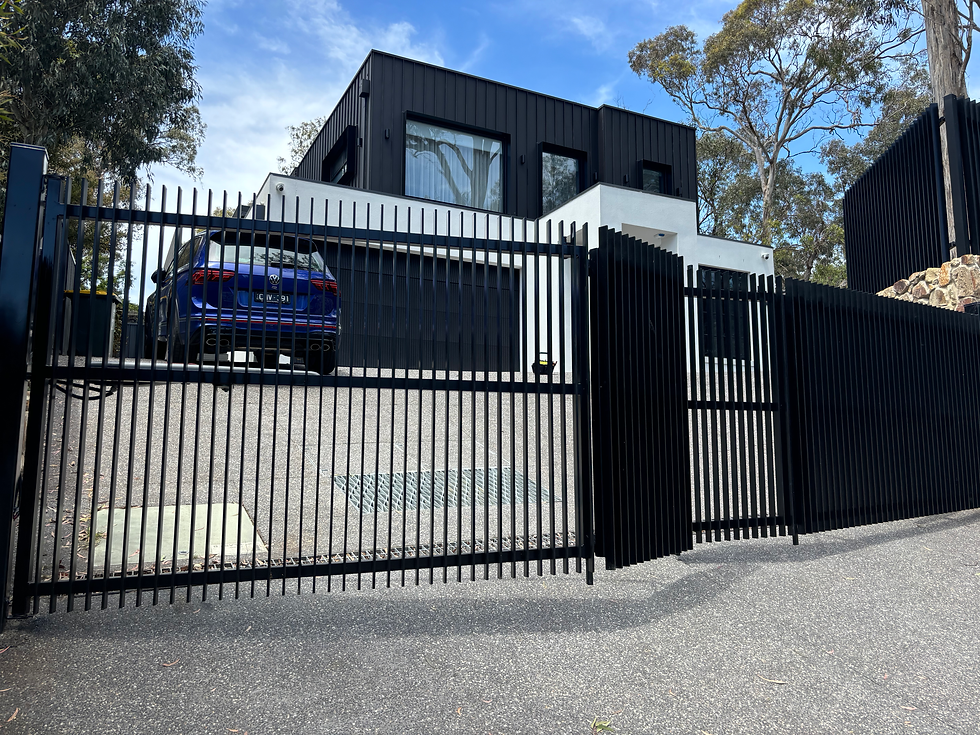
What Should Be Checked Before Finalising an Automatic Driveway Gate?
Before fabrication begins, assess how the entrance will work during the actual vehicle manoeuvre. Measurements taken only along the fence line do not show how a trailer will behave when approaching from the street.
A practical pre-installation check should cover:
Largest regular vehicle: Measure the caravan, trailer, motorhome or delivery vehicle the entrance needs to accommodate.
True clear opening: Measure between the closest fixed obstructions once the gate is fully open.
Approach angle: Check how the tow vehicle actually travels from the road into the driveway.
Swept path: Allow for trailer tracking, rear overhang and steering corrections.
Street conditions: Consider kerbs, traffic, on-street parking and available turning room.
Existing crossover: Check whether it aligns effectively with the proposed opening.
Internal driveway: Confirm there is enough clearance after the vehicle passes through the gate.
Gate travel: Keep sliding run-back areas and swing arcs clear.
Automation equipment: Avoid placing motors, photocells, intercoms or other equipment where they unnecessarily reduce clearance.
Pedestrian visibility: Maintain useful sightlines around the footpath and driveway crossover.
Council requirements: Check relevant planning and council requirements before altering the frontage or vehicle crossover.
Plan Your Wide Driveway Gate Entrance With LATITUDE Fencing & Gates
If you regularly tow a caravan, boat or trailer, the best time to plan access is before the gate posts, foundations and opening position are fixed. Increasing an entrance after fabrication may require changes to fencing, structural posts, tracks, footings and automation.
LATITUDE Fencing & Gates designs, manufactures and installs custom sliding, swing, telescopic and bi-fold driveway gates across Melbourne. We can assess vehicle dimensions, driveway and crossover geometry, clear opening requirements, sliding run-back, swing clearance, automation, safety devices, intercoms and smart access-control options as part of the complete entrance design.
A properly planned wide driveway gate should make larger-vehicle access comfortable and repeatable, not simply possible under perfect conditions. Planning a wide driveway gate for a caravan, trailer or larger vehicle? Contact LATITUDE Fencing & Gates today!

Frequently Asked Questions
How wide should a driveway gate be for a caravan?
There is no single opening width that suits every caravan and property. Measure the caravan's actual overall width, including projecting equipment, then assess its approach angle and swept path.
Is a 3-metre driveway gate wide enough for a caravan?
It may be suitable in some situations, but the dimension alone cannot confirm whether access will be practical. For a caravan approaching almost straight-on, 3 metres may provide usable clearance depending on its actual dimensions.
How much clearance should there be beside a caravan when entering a gate?
Instead of using one fixed clearance figure, allow enough space for the way the caravan will actually approach the entrance. The driver should have reasonable tolerance for steering correction rather than needing centimetre-perfect positioning. The necessary margin therefore depends on caravan width, approach angle, drawbar and axle position, street width and the turning path.
Is a sliding or swing gate better for caravan access?
Both can work well. Sliding gates keep the gate leaf out of the driveway and are particularly useful when a caravan needs maximum internal manoeuvring depth. Swing gates can provide substantial openings but require enough space for the leaves to open without conflicting with the tow vehicle or caravan.
Can a driveway gate be widened without changing the crossover?
Sometimes, but widening the gate does not automatically make the crossover wider or improve the vehicle's approach path. If the existing crossover is significantly narrower or poorly aligned with the proposed opening, the caravan may still need a difficult turn.
How do I measure my driveway for a caravan gate?
Start with the vehicle rather than the fence. Record the caravan and tow vehicle dimensions, then observe the combination approaching the property.
Measure the available gate opening, crossover, driveway width and space along the fence line. Also check how far the gate can be set back from the footpath and where a sliding gate could run or swing leaves could travel.


Comments