
Front Fence Contractor Quote Comparison: Seven Details Homeowners Often Miss

Key Takeaways
Compare the full scope, not just the total price. A cheaper quote may exclude permits, demolition, waste removal, structural work or site cleanup.
Check permit and approval responsibilities. Confirm who assesses planning or building permit requirements, prepares documents and pays application or surveyor fees.
Clarify boundary and underground service checks. Make sure the quote explains who verifies the fence line, locates services and handles unexpected site conditions.
Look closely at structural details. Compare post depth, footing dimensions, concrete specifications and gate hardware, as these can affect long-term fence and gate performance.
Ask about installation sequencing and curing. Heavy gates and structural supports may need appropriate curing time before full loads are applied, so the fastest timeline is not always the best.
Confirm demolition, disposal and cleanup inclusions. Check whether removal of the existing fence, old footings, soil, vegetation and construction debris is included.
Read the warranty conditions, not just the number of years. Compare workmanship coverage, material warranties, exclusions and the process for getting support if problems develop after installation.
When Melbourne homeowners request several quotations for a new front fence, the prices can sometimes be different. At first glance, each contractor may appear to be quoting on the same fence, gate and materials, so choosing the lowest number can seem like the obvious decision.
However, a front fence contractor quote is only useful when you understand exactly what is included behind that final price. One contractor may include demolition, concrete footings, gate hardware, waste disposal and site cleanup, while another may treat some of those items as exclusions or later variations. A meaningful comparison therefore needs to look at scope, specification and responsibility - not simply the number at the bottom of the page.
Here are seven details homeowners often miss.
1. Check Whether Permits and Approval Costs Are Included in the Front Fence Contractor Quote
Permit requirements can affect both the cost and timing of a front fence project. A small note saying “permits excluded” may seem unimportant when comparing quotations, but it can leave the homeowner responsible for design changes later.
Planning Permits
Whether your fence requires a planning permit depends on the property, planning controls, overlays and proposed design.
Victorian residential development provisions include front-fence standards that generally provide maximum heights of 2 metres for streets in Transport Zone 2 and 1.5 metres for other streets where the relevant standard applies. However, local planning controls, zone schedules and overlays can alter what is permitted, so these figures should never be treated as universal approval limits.
Building Permits
A building permit is different from a planning permit. For example, the City of Boroondara advises that a building permit can be required for masonry front fences higher than 1.2 metres and non-masonry fences higher than 1.5 metres. Additional conditions apply to corner sites, including certain fences within nine metres of an intersection.
Heritage and Other Overlays
Overlays can create additional requirements. In Boroondara, Council states that a planning permit is required to demolish an existing front fence and construct a new one when a property is affected by a Heritage Overlay.
Before accepting a quotation, ask:
Has the property been checked for relevant planning controls?
Who prepares any required drawings or supporting documents?
Who submits the application?
Are council and building-surveyor fees included?
What happens if approval conditions require the design to change?
An experienced contractor should raise potential approval issues early rather than allowing them to appear after construction has been scheduled.

2. Clarify Who Pays for Boundary Surveys and Site Verification
The existing fence line should not be assumed to represent the legal property boundary. Older fences may have been installed decades ago, altered by previous owners or positioned around landscaping and other obstacles. This becomes particularly important when the project includes:
masonry piers or rendered walls;
high-value aluminium or steel fencing;
automatic driveway gates;
pedestrian gates;
retaining structures; or
construction close to neighbouring improvements.
Never Assume the Old Fence Is Correct
Imagine receiving two quotations.
Quote A simply assumes the existing fence line is correct.
Quote B clearly states that the homeowner must provide confirmed boundary information where the legal boundary cannot be established confidently.
Quote B may initially feel less convenient, but it provides greater clarity about responsibility before work starts.
Determine Who Carries the Risk
Ask whether boundary verification is recommended, whether a licensed surveyor may be required and who will organise and pay for that work. Most importantly, establish what happens if the surveyed boundary differs from the line originally assumed during quoting.
A good quotation should identify important assumptions that could materially affect the project rather than leaving them to be resolved during excavation.
3. Confirm Underground Utility Checks Before Digging Starts
Fence construction often requires excavation for posts, masonry piers, gate supports and electrical conduits. That means underground services need to be considered before excavation begins.
Before choosing a contractor, establish how the following issues are handled:
Service-location responsibility: Confirm whether the contractor arranges available underground-service information or expects the owner to organise it.
Private services: Utility information may not identify every privately installed irrigation line, garden-light cable, drainage pipe or electrical service within the property.
Gate automation: Automatic gates may require power, communication cabling, photocells, intercoms, keypads and other access-control devices. Conduit planning is much easier before concrete, paving and landscaping are finished.
Unexpected obstacles: Ask what happens if excavation encounters rock, old concrete, tree roots, drainage or undocumented services.
Variations: Establish how unexpected excavation or relocation work will be priced and approved.
Consumer Affairs Victoria recommends documenting variations and changes to costs rather than relying on informal assumptions. For regulated domestic building contracts, particular variation requirements may also apply.
The important question is not simply whether service checks occur. It is who is responsible and what happens when actual site conditions differ from expectations.
4. Compare the Fence Structure, Not Just the Visible Materials
This is one of the most important parts of any front fence contractor quote comparison.
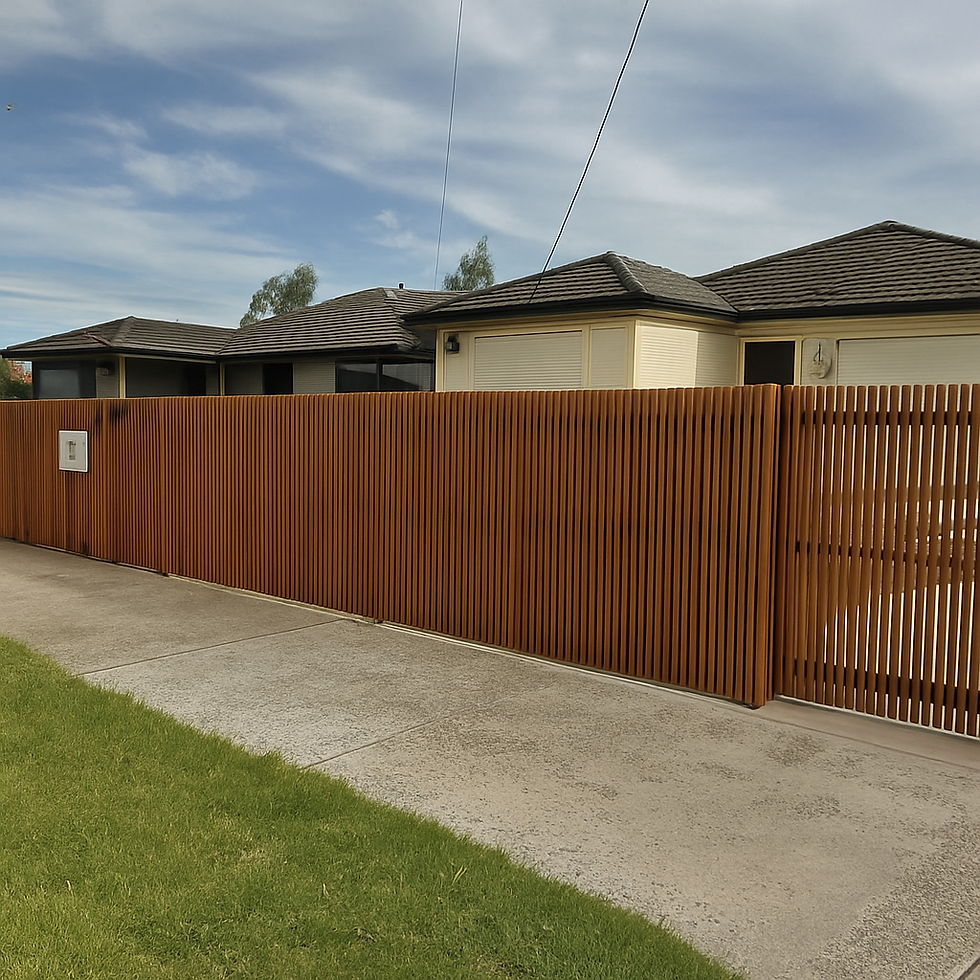
Two fences can look almost identical when completed while having very different structural specifications underneath. Homeowners naturally compare colours, slat profiles and fence heights, but posts, footings and hardware can have a much greater effect on long-term performance.
Detail 1: Post Depth and Footing Design
You may hear general rules of thumb suggesting that roughly one-third of a fence post should be below ground. While such guidelines can be useful for basic discussion, post depth should not be treated as one fixed specification for every fence.
The appropriate design depends on factors including:
fence height;
post dimensions and material;
soil conditions;
wind exposure;
gate loads;
ground levels;
retaining pressure; and
whether the construction is lightweight or masonry.
Where the design has already been determined, a detailed quotation should provide more information than simply saying “posts concreted into ground”.
Detail 2: Concrete Footings
Look at what each contractor has allowed for beneath the fence. Useful details may include:
hole or footing dimensions;
concrete specification or quantity;
reinforcement where required;
treatment of existing concrete;
excavation through difficult ground; and
additional support for gate posts or masonry.
Insufficient foundations may not be obvious when the fence is first installed. Problems can appear later through leaning posts, movement, cracking or gates falling out of alignment.
Detail 3: Gate Hardware
A quotation that simply says “supply and install gate” leaves many questions unanswered. Instead, you should compare:
hinges;
latches and locks;
drop bolts;
adjustable or fixed hinges;
sliding tracks and rollers;
corrosion-resistant components;
self-closing hardware where required; and
provision for future automation.
For an automatic driveway gate, it is also important to confirm whether the price covers only the fabricated gate or also includes the motor, safety devices, access control, electrical work and commissioning.

5. Ask How Concrete Cure Time Fits Into the Schedule
Fast completion sounds attractive, but faster is not automatically better.
Fence posts, masonry elements and large gate supports can place considerable loads on newly installed footings. Appropriate concrete setting and curing arrangements depend on the concrete used, weather conditions, structure and loads involved.
Rather than looking for one universal number of hours or days, ask the contractor to explain the installation sequence. Questions worth asking include:
When will the posts or piers be installed?
When will fence panels be attached?
When will heavy driveway gates be hung?
Is adequate curing allowed before full loads are applied?
Could hot, cold or wet weather change the schedule?
This becomes particularly important with wide swing gates, large sliding gates and heavy steel fabrication because their supports experience greater forces than ordinary fence panels.
6. Find Out Exactly What Happens to the Old Fence and Site Debris
Demolition and waste disposal are common reasons two similar fencing quotations have different totals. Before comparing prices, determine exactly how each contractor handles the existing site. Important items include:
Existing fence demolition: Is removal of the current timber, metal or masonry fence included?
Old footings: Will old concrete footings be excavated, or will existing posts be cut below ground?
Waste disposal: Are disposal and tipping costs included in the quoted price?
Excavated soil: Who removes soil generated by new post holes and footings?
Vegetation: Is clearing vegetation around the fence line included?
Property protection: How will paving, driveways, gardens and neighbouring property be protected?
Final cleanup: Will packaging, metal offcuts, excess concrete and other construction waste be removed?
Consumer Affairs Victoria recommends written contracts that clearly describe the work and specifications so both parties understand their obligations. If one quotation is dramatically cheaper than another, check whether demolition and cleanup have been omitted.

7. Read the Warranty Beyond the Number of Years
A “five-year warranty” does not mean better protection than a “two-year warranty”. The real value depends on what is covered, what is excluded and how claims are handled.
Workmanship Warranty
Ask what happens if a problem develops because of fabrication or installation. This may include issues such as:
poor fence alignment;
installation-related movement;
faulty fabrication;
incorrectly installed panels; or
workmanship-related gate problems.
LATITUDE Fencing & Gates provides after-completion support for workmanship issues, with applicable warranty conditions documented for the project.
Material and Finish Warranties
Fence components may also be covered by separate manufacturer warranties. Powder coating, timber, gate motors, locks and access-control products can all have different warranty conditions. Check whether exclusions apply to matters such as:
fading;
corrosion;
coastal exposure;
timber movement;
normal wear;
accidental damage;
misuse; or
alterations by another contractor.
Statutory Rights and Written Warranties
A contractor's written warranty is not the full extent of your legal rights. Consumer Affairs Victoria explains that implied warranties under the Domestic Building Contracts Act apply to domestic building work and include requirements relating to proper workmanship, suitable materials, legal compliance and reasonable care and skill.
Consumer guarantees may also apply under Australian Consumer Law, and these statutory protections cannot simply be signed away.
One useful question is: “What happens if my fence or gate develops a workmanship problem twelve months after installation?” The answer may tell you more about the contractor than the warranty headline itself.

8. How to Compare Front Fence Contractor Quotes Side by Side
Once you have collected several quotations, avoid comparing totals until you have put the specifications side by side.
Detail | What to Compare |
1. Permits | Responsibility, drawings, application costs and exclusions |
2. Boundary survey | Whether verification is needed and who pays |
3. Utility checks | Responsibility and treatment of unexpected site conditions |
4. Structural installation | Posts, footings, concrete and gate hardware |
5. Cure time | Construction sequence and loading of posts or piers |
6. Removal & cleanup | Demolition, disposal, soil removal and restoration |
7. Warranty | Workmanship, materials, exclusions and claims process |
Once these items are aligned, consider four broader questions:
Is the specification detailed enough for another contractor to price approximately the same scope?
Which costs are fixed and which could become variations?
Has the contractor explained why particular materials and construction methods were selected?
Who remains responsible if an installation issue appears after completion?
In short, compare multiple written quotations for the same plans and specifications and look beyond price to factors such as communication, value for money and whether the finished work is likely to match the agreed contract.
At LATITUDE Fencing & Gates, our consultation and quoting process is designed to clarify fence design, materials, site conditions, gates and installation scope before construction. Instead of relying solely on a generic per-metre price, we assess the requirements relevant to each Melbourne property and develop a project-specific fencing solution.
In Conclusion
A front fence contractor quote should be treated as a description of the finished project, not simply a price.
The more clearly a quotation addresses permits, boundaries, underground services, footings, gate hardware, construction sequencing, demolition and warranty support, the easier it becomes to make an informed decision and reduce unexpected costs later.
Planning a new front fence in Melbourne? Contact LATITUDE Fencing & Gates team today. We can assess your property, discuss timber, aluminium, steel, PVC, Colorbond and custom gate options, and prepare a tailored quotation based on the installation requirements of your project.
FAQs
Should I always get three quotes for a front fence?
Comparing several quotations is useful, but the quotations should cover the same design, materials, structural requirements, demolition and finishing scope. Consumer Affairs Victoria recommends comparing at least three written quotes for the same plans and specifications.
Does a front fence contractor arrange council permits?
Sometimes, but never assume they are included. Confirm in writing who checks requirements, prepares applications, pays council or surveyor fees and handles approval-related design changes.
Why can two quotes for the same front fence be so different?
Differences may involve material specifications, foundations, hardware, demolition, difficult access, permits, waste removal, automation requirements and warranty coverage, not simply the contractor's labour rate.
Should footing details appear on a fencing quote?
Where footing requirements have already been determined, documenting key dimensions and specifications makes quotes easier to compare. Complex masonry, retaining or large-gate structures may require project-specific engineering advice.
What should I ask before paying a deposit?
Confirm materials, scope, permits, payment terms, expected timing, variations, demolition, cleanup and warranties. Important verbal promises should also appear in the written quotation or contract.


Comments