
How to Choose a Driveway Gate for a Short Driveway

Key Takeaways: Before choosing, measure the driveway, normal parking position, gate movement zone and available frontage together so the finished entrance works comfortably with everyday vehicle access.
A sliding gate can preserve driveway depth where sufficient side run-back exists.
A telescopic gate can reduce the run-back needed on a narrow frontage, while a bi-fold gate can help where both side space and driveway depth are restricted.
Conventional swing gates may still work when vehicle clearance is adequate.
On compact Melbourne blocks, there may be only a few metres between the front boundary and the garage, carport or normal parking position. When considering how to choose driveway gate designs for a limited-space entrance, driveway width is only one measurement.
The key principle is simple: choose the gate around vehicle movement first and gate appearance second. For this reason, sliding, telescopic and bi-fold gates can sometimes make better use of a compact frontage than conventional inward-opening swing gates.

How to Choose Driveway Gate Types for a Short Driveway
There is no single gate type that works best for every short driveway. The right configuration depends on where the available space is limited.
Choose a Sliding Gate When You Need to Keep the Driveway Depth Clear
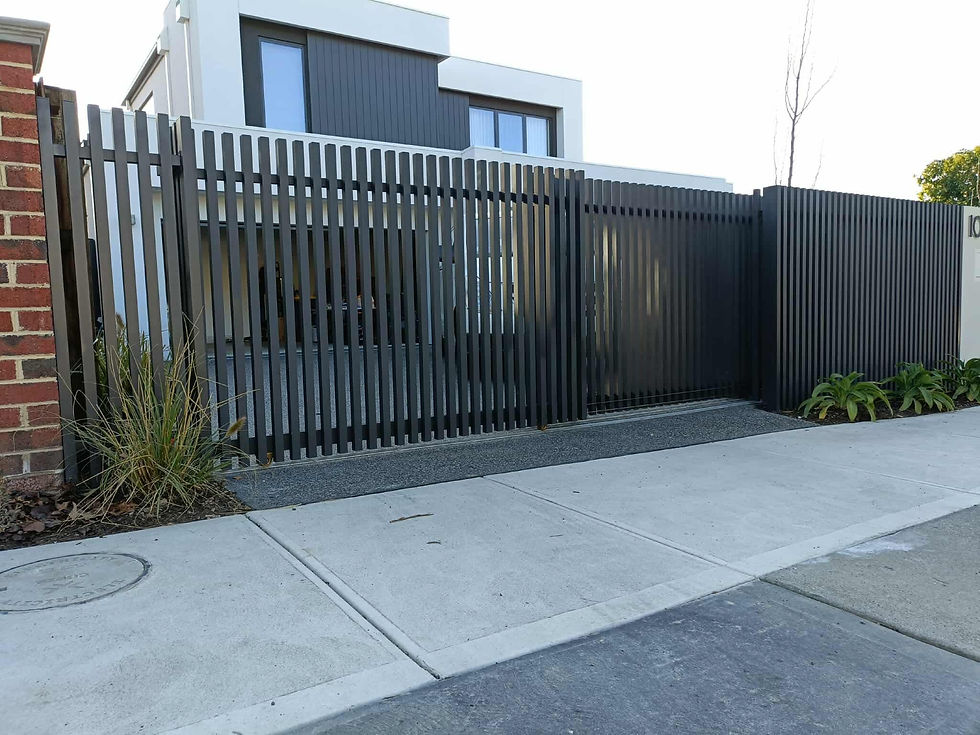
A conventional sliding driveway gate is often the first option worth investigating for a short driveway. Instead of swinging towards the parked vehicle, the gate moves sideways along the fence line. This keeps the opening arc out of the driveway and can allow a vehicle to park relatively close behind the closed gate.
A sliding gate can offer several advantages on compact properties:
No inward swing area needs to remain clear.
More of the driveway depth can be used for parking.
The gate moves parallel to the front boundary.
Automation can be integrated easily.
The configuration works well with aluminium slat, vertical batten and picket-style fencing.
The main limitation is side run-back space. A conventional single sliding gate usually requires enough clear fence line beside the driveway for the gate leaf to travel away from the opening. A wide driveway therefore requires a substantial amount of usable space on one side.
Check the proposed run-back area for pedestrian gates, side boundaries, meter boxes, letterboxes, landscaping, retaining walls, fence posts and changes in ground level.
A gate may fit across the driveway perfectly while having nowhere to go once it begins opening. That is why both the driveway opening and available side space should be measured before selecting a conventional sliding design.

Consider a Telescopic Sliding Gate When Side Run-Back Is Limited
A telescopic sliding gate can provide a useful alternative when you want the space-saving advantages of a sliding gate but do not have enough fence line for one large leaf. Instead of moving as one complete panel, the gate is divided into multiple sections. These sections move together and overlap or stack as the entrance opens.
Because the panels retract into a shorter area, the system can reduce the lateral run-back required beside the driveway.
Telescopic gates are particularly useful where the driveway opening is relatively wide but the remaining frontage is narrow. They may also suit townhouse blocks, entrances beside pedestrian gates, properties where landscaping limits the fence line or sites where the house itself sits close to the driveway.
The trade-off is additional mechanical complexity. Panel alignment, tracks or guides, structural support and automation all need to operate together accurately. For that reason, telescopic systems benefit from being designed as a complete gate and automation solution rather than adapting a standard gate after fabrication.
Use a Bi-Fold Gate When Both Driveway Depth and Side Space Are Restricted
What happens if there is not enough side run-back for a sliding gate and not enough driveway depth for conventional swing leaves? A bi-fold driveway gate may provide the answer.
Rather than using one long swing leaf on each side, a bi-fold system divides the gate into shorter sections that fold together during opening.
Think of the difference as:
Conventional swing gate → larger opening arc
Bi-fold swing gate → shorter folding arc
Reducing the projection of each leaf can make a considerable difference on a shallow driveway. Bi-fold gates can therefore suit properties where walls, gardens, buildings or neighbouring boundaries restrict both the front and sides of the entrance.
They can also appeal to homeowners who prefer the appearance of swing gates but cannot accommodate full-length swing leaves.
Bi-fold gates still require some internal operating space. The folding sections need a clear movement zone, so the normal parked position of the vehicle should be considered before the gate is fabricated.
Accurate alignment is also important because hinges, folding points and automation must work together consistently.

Can a Swing Gate Work on a Short Driveway?
Yes. A conventional swing gate can still work on some short driveways, but there must be sufficient clearance between the opening leaves and the vehicle.
The problem is that standard inward-opening leaves can consume a surprisingly large proportion of a shallow driveway. Rather than looking only at the driveway gate width, map the entire sequence:
Front boundary → gate → parked vehicle → garage or carport
Consider where the front of an SUV or ute will sit after it has been parked. Then map the gate's complete opening arc. A gate that technically fits across the entrance may still be impractical if the leaves collide with a parked vehicle or force the driver to park too close to the garage.
Swing gates may still suit a relatively narrow gateway, smaller gate leaves or properties where the driveway geometry allows the leaves to open alongside the vehicle rather than towards it.

Key Factors to Evaluate Before Selecting the Gate
Once you have identified the gate configurations that could physically work, look more closely at how the property will actually be used. Small differences in dimensions can change which system is practical.
Side Clearance
For a sliding gate, measure the available fence line beside the opening rather than assuming the frontage is long enough. Moreover, remember that usable run-back space can be reduced by pedestrian entrances, brick piers, meter boxes, retaining walls and landscaping.
When there is insufficient space for one complete sliding leaf, a telescopic configuration may be worth considering.
Vehicle Overhang
Vehicle length becomes especially important on a shallow driveway. Do not measure only to the garage wall. Identify where the vehicle is realistically parked, including clearance around the garage door, carport posts and pedestrian pathways.
When comparing how to choose driveway gate configurations, test the gate movement against your longest regularly used vehicle rather than relying purely on the dimensions of the driveway.
If the gate and parked vehicle occupy the same area during operation, another opening system is generally required.
Automation and Safety Devices
Automatic gates need a properly considered movement and detection zone.
Photoelectric safety beams, appropriate controls and other safety devices can help detect vehicles or obstructions around the gate's path. Their positioning becomes particularly important on short driveways because vehicles may regularly stop close to the gate.
For sliding systems, the physical gate also needs appropriate support, guides and stops. WorkSafe Victoria's guidance on motorised sliding gates highlights correct support as well as appropriate end stops and catches at the limits of travel.
Material and Gate Weight
Material selection can influence both the appearance and operation of the gate.
Powder-coated aluminium is a popular option for residential sliding, telescopic and bi-fold gates because it can provide a relatively lightweight structure while offering a wide variety of slat, batten and picket designs.
Weight is only one consideration, however. Gate dimensions, wind exposure, infill design, structural requirements and frequency of operation all affect the final system.

How Should Gate Automation and Access Control Be Planned on a Compact Driveway?
A short driveway changes more than the physical gate. It also affects how residents and visitors approach, activate and pass through the entrance.
The gate motor should be selected according to the complete system, including gate size and weight, opening configuration, operating frequency, wind loading, mechanical resistance, desired movement, safety equipment and access control requirements.
Remote controls or smart app access can allow the gate to begin opening before the vehicle reaches the entrance. This can reduce unnecessary stopping immediately outside the property.
An intercom positioned too close to the gate may leave a vehicle partly across the footpath while the driver communicates with the house.
A keypad or RFID reader can create the same issue if the driver cannot reach it from a sensible stopping position.
Safety sensors also need to cover the gate's movement zone appropriately, particularly where cars may remain close to the entrance while the gate closes. Vehicle detection can also form part of the automation strategy where appropriate.
For sliding gates in particular, proper stops, guides and support arrangements matter. WorkSafe Victoria's guidance following a fatal motorised sliding-gate incident stresses the importance of adequate end stops, catches and correct gate support.
At LATITUDE, automation can also be integrated with intercoms, smart CCTV, smart locks, mobile app control and compatible smart-home systems. This means the physical gate and the way people access the property can be planned together.

What Planning and Boundary Issues Should Melbourne Homeowners Check?
Before finalising a driveway gate, confirm exactly where the private property ends and what approvals may apply.
Requirements vary between properties according to the planning zone, overlays, fence design, height, street conditions and individual council requirements.
Start by confirming the title boundary. Do not assume the footpath, nature strip or vehicle crossover forms part of the private property simply because it sits directly in front of the home.
Homeowners should also check whether a planning permit, building permit or other council approval applies before construction starts. Consumer Affairs Victoria advises homeowners to determine the planning and building requirements applying to their project and notes that local council requirements can vary.
Victorian residential guidance provides that where no different maximum is specified in the relevant zone schedule, a front fence within three metres of a street has a maximum height of 1.5 metres on other streets and 2 metres on streets in Transport Zone 2. Site-specific planning controls still need to be checked.
Sightlines can also be important near intersections and driveways. If the project involves constructing, widening or relocating the vehicle crossover, separate council approval may be required.

How Can LATITUDE Design a Driveway Gate Around a Limited-Space Entrance?
A short driveway is a good example of why a driveway gate should be designed around the property rather than selected from a standard catalogue.
Before recommending a system, LATITUDE Fencing & Gates can assess the available driveway depth, opening width, normal vehicle position, sliding run-back, swing zones, ground levels, existing fencing, pedestrian access and automation requirements.
From there, the site may suit a conventional sliding gate where adequate run-back exists, a telescopic sliding gate where side space is restricted, a bi-fold system where both depth and lateral space are limited, or a custom swing gate where the geometry provides sufficient clearance.
Understanding how to choose driveway gate solutions for compact properties ultimately comes down to making the physical gate, vehicle movement and access system work together.
LATITUDE can manage the design, fabrication, installation and automation of your driveway gate, with options including intercoms, app control, CCTV and integrated smart access.
Planning a driveway gate for a short Melbourne driveway? Contact the LATITUDE Fencing & Gates team for an obligation-free consultation. We can assess the available space and develop a custom gate layout suited to your vehicle access, frontage and automation requirements.

FAQs
What is the best driveway gate for a short driveway?
A sliding gate is often a good starting point because it does not require an inward opening arc. However, the best solution depends on the available side run-back. Where side space is limited, a telescopic sliding or bi-fold gate may make better use of the available area.
Can I install a sliding gate if there is not enough space beside my driveway?
A conventional sliding gate may not work without sufficient run-back. A telescopic sliding gate can sometimes overcome this problem by dividing the gate into multiple overlapping sections, reducing the space required beside the opening.
How much space does a swing driveway gate need to open?
The required space depends on the width and configuration of the gate leaves. The complete opening arc should be mapped against the normal vehicle position before fabrication to ensure the gate cannot strike a parked vehicle.
Are telescopic gates suitable for residential driveways?
Yes. Telescopic gates can be particularly useful for narrow Melbourne blocks or wide driveway openings where there is insufficient frontage for a conventional sliding gate. Accurate fabrication, guidance and automation are important because several moving sections must operate together.
Can a driveway gate open outward towards the street?
Do not assume an outward-opening gate is permitted. The gate must remain within the property's applicable boundaries and must not obstruct public areas. Always check the requirements applying to your property.


Comments