
How to Choose a Local Front Fence Installer in Melbourne’s Eastern Suburbs
- Thuy Phung
- 11 minutes ago
- 9 min read

Key Takeaways: A reliable front fence contractor should have appropriate credentials for the work, current insurance, relevant local experience and a clear understanding of the material you want installed.
Look closely at previous workmanship rather than choosing from attractive gallery photos alone.
Confirm installation responsibilities, project timing and warranty support.
Comparing contractors on the complete scope and quality of service is more useful than simply selecting the lowest quoted price.
Choosing a front fence installer Melbourne East homeowners can rely on involves much more than comparing two prices for fences that look similar on paper. The contractor who understands council requirements, materials, fabrication, site conditions and gate installation can significantly affect the finished result.
Across Boroondara, Whitehorse, Manningham, Monash and Knox, properties can be affected by different zones, overlays and site conditions. Before accepting a quote, it is worth assessing both the contractor and exactly what they propose to deliver.

Start With the Installer’s Credentials, Insurance and Business History
Before comparing fence designs, establish who you are dealing with. A professional-looking website or social media gallery does not by itself confirm whether a contractor has the appropriate registration, insurance or business structure for your project.
Check Whether Registration Is Required for Your Project
Victoria does not have one simple rule saying every person installing a fence needs a generic “fencing licence”. The requirements depend on the nature and value of the work.
Consumer Affairs Victoria states that a builder must generally be registered with the Building and Plumbing Commission and use a major domestic building contract for applicable domestic building work costing more than $10,000. Its guidance specifically includes fencing when it forms part of work associated with building, repairing, renovating or extending a home.
If registration applies, homeowners should check that the individual practitioner holds the appropriate registration instead of relying only on a business name or verbal assurance.
Ask for Current Insurance
Ask the contractor to provide evidence of current public liability insurance. Consumer Affairs Victoria recommends checking insurance when selecting builders and tradespeople.
When reviewing the certificate, check that:
The insured business or practitioner corresponds with your quotation;
The policy is current;
The work being undertaken is appropriately covered; and
The level of cover is suitable for the project.
For applicable domestic building projects, additional Victorian insurance requirements can also apply. From 1 July 2026, Home Warranty insurance applies to qualifying work over $20,000 on homes of up to three storeys.
Check the Business Behind the Quote
Look for an identifiable ABN or business entity, established contact details and examples of recently completed work. A traceable business is considerably easier to deal with if questions arise during installation or after the project is finished.

Choose a Front Fence Installer Melbourne East Homeowners Can Trust With Local Requirements
Local knowledge matters because residential fencing requirements cannot safely be reduced to statements such as “anything under this height doesn't require approval”.
Planning requirements may depend on the local planning scheme, residential zone, property size, number of dwellings, road classification, overlays, corner-site conditions and previous planning approvals.
Front Fence Rules Vary Between Properties
A property only a few streets away from another can have different planning considerations. Therefore, before finalising a fence, it is essential to consider relevant factors:
Residential zoning;
Heritage controls;
Neighbourhood character requirements;
Landscape overlays;
Lot size;
Multiple dwellings on one property;
Corner or intersection locations;
Front fence height and construction;
Main or declared road conditions; and
Existing planning permits.
A contractor does not necessarily need to act as your town planner, but they should understand when a design requires further checks instead of fabricating first and asking questions later.
Boroondara Is a Good Example of Why Local Knowledge Matters
Many properties in suburbs such as Camberwell, Hawthorn, Kew and Canterbury have established streetscape or heritage considerations.
Boroondara Council advises owners to check applicable overlays before replacing a front fence. For properties affected by a Heritage Overlay, its guidance states that a planning permit is required to demolish an existing fence and build a replacement. Environmental Significance and Significant Landscape overlays can also affect requirements.
That is exactly why assumptions based only on fence height can be problematic.
Corner Sites Need Additional Attention
Corner properties and driveways near intersections can have additional visibility requirements. Fence height, solid sections, gate placement and landscaping may all affect sightlines.
A good local contractor should identify these potential constraints during the early design stage and explain which matters need to be confirmed before manufacturing starts.
Look for Experience With the Fence Material and Style You Actually Want
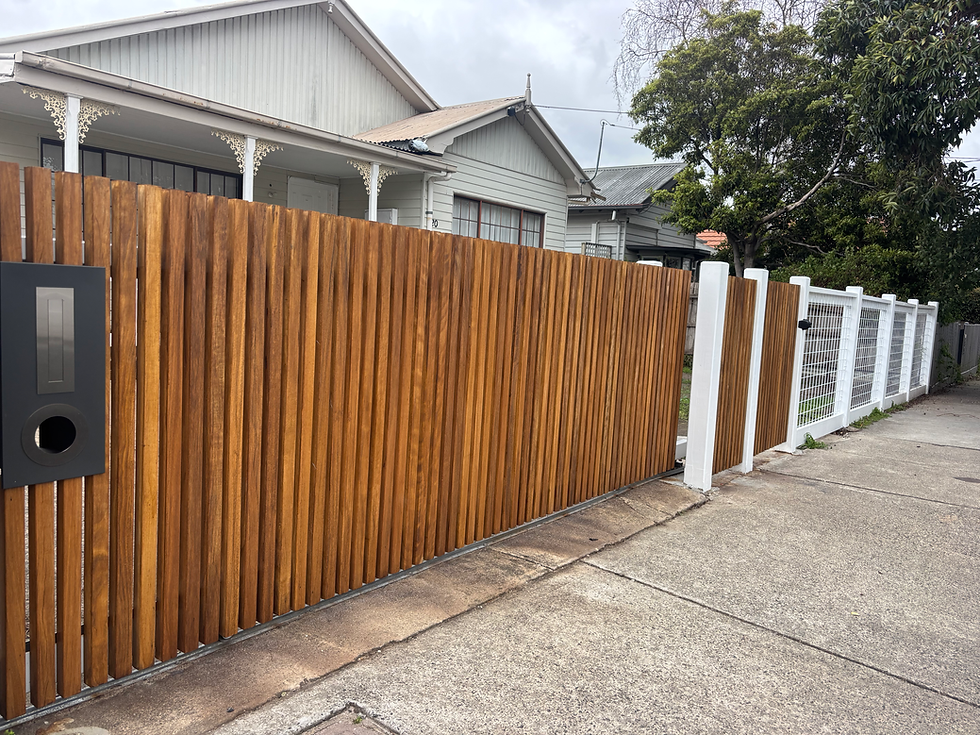
A contractor who installs one type of fencing every week might not be experienced with custom aluminium, timber battens, automated gates or detailed steel fabrication.
When choosing between front fence contractors eastern suburbs Melbourne homeowners should look for projects that resemble the fence they actually intend to build.
Review Comparable Projects
Ask to see completed examples such as:
Timber pickets for Victorian, Edwardian or Californian Bungalow homes;
Merbau or other timber battens around renovated residences;
Vertical aluminium battens for contemporary homes and townhouses;
Horizontal aluminium slats for modern privacy fencing;
Steel tubular designs where visibility and security are priorities; and
Automatic driveway gates integrated into matching front fencing.
Projects similar to your own provide much more useful information than a collection of unrelated finished fences.
Inspect the Details
A fence can look impressive from the street while poor detailing around gates and connections causes problems later. As a result, do not judge workmanship from the wide-angle photograph alone. Look more closely at:
Whether posts are aligned;
Consistency of batten and picket spacing;
Weld quality;
Powder-coated finishes;
Gate-to-post clearances;
Panel connections;
Transitions into masonry; and
How fencing follows sloping or uneven ground.
Consider Custom Design Capability
Many Eastern Melbourne properties cannot be resolved with standard panels alone. Existing masonry piers, mature gardens, narrow driveways, sloping boundaries or unusual frontage dimensions may require the fence, pedestrian gate and driveway gate to be designed together.
At LATITUDE Fencing & Gates, we design and manufacture custom aluminium, steel and timber fencing alongside pedestrian and automatic driveway gates, helping maintain one consistent frontage rather than assembling unrelated components.

Make Sure the Installer Assesses Your Actual Site Before Finalising the Design
A site inspection can reveal constraints that are almost impossible to understand from a frontage width and a few mobile-phone photos. Before providing a final construction solution, an experienced front fence installer Melbourne East properties should consider several site conditions.
Important checks include:
Ground level and slope: A sloping frontage may require stepped or raked panels, different post lengths and specific treatment around gates. Even a modest driveway gradient can affect how a swing gate operates.
Soil and footing conditions: Soil conditions vary throughout Melbourne's east. Fence posts, gate posts and heavier structural elements need foundations appropriate to the individual site rather than relying on one standard footing approach.
Existing trees: Mature trees and established gardens can affect post locations, excavation and access during installation. Roots can also influence where a fence line can practically be constructed.
Existing masonry or retaining structures: Old brick piers or walls should not automatically be assumed suitable for supporting a new fence or automated gate. Their condition and suitability need to be assessed.
Driveway gradient and available space: Sliding, swing, telescopic and bi-fold gates each require different operating space. The best configuration depends on the driveway rather than simply the homeowner's preferred gate type.
Existing services: Underground electrical, gas, water, drainage or communication services should be considered before excavation and post-hole locations are confirmed.
Reliable pricing should follow a clear understanding of the site, particularly for customised fencing and automated gates.
Compare Front Fence Quotes on Scope, Not Just Price
Getting several quotes is useful only when the contractors are pricing comparable work. Consumer Affairs Victoria recommends obtaining at least three quotes based on the same plans and specifications.
What Should an Itemised Front Fence Quote Include?
Depending on the project, look for clear information covering:
Overall fence dimensions and approximate length;
Material and profile;
Posts and structural components;
Paint, stain or powder-coated finish;
Pedestrian gates;
Hinges, tracks, rollers and hardware;
Gate automation where applicable;
Existing fence removal;
Excavation and concrete;
Rubbish removal and disposal;
Delivery;
Installation labour;
Permit or design responsibilities and exclusions; and
GST.
The more clearly the scope is described, the easier it becomes to compare contractors fairly.
Be Careful With an Apparently Cheap Quote
One quote may be several thousand dollars cheaper simply because it does not include demolition, disposal, difficult excavation, automation hardware or custom fabrication.
The important question is not only “How much does it cost?” but also “What exactly am I receiving for this price?”
Ask How Variations Will Be Managed
Unexpected conditions sometimes appear after work begins. What matters is how the contractor deals with them.
Ask whether additional work will be explained and approved before extra costs are incurred. For larger domestic building contracts, Victorian requirements also place considerable importance on clearly documenting the agreed works, specifications and contract price.

About Installation Method, Timeline and Project Management
Good fabrication can still produce a disappointing outcome if the installation itself is poorly planned. During the consultation, ask practical questions about how the job will progress.
Useful questions to ask a front fence contractor before signing a quote include:
Who will install the fence? Ask whether the contractor's regular installation team completes the work or whether installation will be subcontracted.
How are posts and footings determined? Post and footing requirements should respond to fence height, gate loads, soil conditions and site characteristics rather than one universal depth.
When will materials be ordered? Custom aluminium fabrication, powder coating, specialist hardware and gate automation can all affect lead times.
How long will the onsite work take? Manufacturing lead time and actual installation time are different, so ask for both.
Who manages permits where required? Confirm whether the homeowner, contractor, building surveyor or another consultant is responsible for each approval.
How are onsite changes communicated? You should know who will contact you if unexpected conditions affect the design, cost or schedule.
LATITUDE follows a straightforward process: obligation-free consultation, design or sketch where required, quotation, acceptance, installation scheduling, onsite communication and after-completion support.
Check the Workmanship Warranty and After-Installation Support
The length of a written warranty is only one consideration. Homeowners should understand what the contractor will actually do if an issue appears after installation. It is important to ask about:
The written warranty period;
What workmanship is covered;
Manufacturer warranties on materials and automation equipment;
Warranty exclusions;
How a problem should be reported; and
Who manages the repair or assessment.
It is also vital to distinguish a contractor's commercial workmanship warranty from rights that exist under Victorian law.
Consumer Affairs Victoria explains that implied warranties apply to domestic building work regardless of cost or whether there is a written contract. These include requirements to carry out work properly and with reasonable care and skill and to use materials suitable for their intended purpose.
LATITUDE provides a 2-year guarantee against defects in workmanship on constructed fencing and gates, together with after-completion support for workmanship issues. For homeowners, knowing that the contractor remains contactable and responsive after installation can be more valuable than simply choosing whoever advertises the largest warranty number.

Choose the Contractor, Not Just the Fence
Choosing a front fence installer Melbourne East homeowners can depend on means looking beyond the cheapest square-metre or lineal-metre price. The quality of the finished frontage depends on site assessment, local knowledge, material experience, fabrication, installation and support after completion.
Compare contractors using the same scope, look carefully at comparable completed projects and make sure potential planning issues are identified before fabrication begins.
Planning a new front fence in Melbourne's eastern suburbs? Contact LATITUDE Fencing & Gates today. Our team can design, manufacture and install a customised front fence, pedestrian gate and automatic driveway gate solution to suit your property, architecture and access requirements.
FAQs
How many front fence quotes should I get?
Consumer Affairs Victoria recommends comparing at least three quotes based on the same plans and specifications. Compare materials, installation scope, exclusions, gate hardware and warranty as well as price.
Does a front fence installer need to be registered in Victoria?
It depends on the project. Applicable domestic building work over $10,000 generally requires a registered building practitioner and major domestic building contract. Work requiring a building permit can also trigger registration requirements. Check the circumstances of your particular project.
Do I need council approval for a new front fence?
Possibly. Requirements can depend on height, construction, property zoning, overlays, road conditions and other site-specific factors. Heritage controls are particularly important in some Eastern Melbourne suburbs. Always check the requirements applying to your property before construction.
Should an installer visit my property before quoting?
For a custom front fence, an onsite assessment is highly valuable. Existing trees, slopes, retaining structures, masonry, driveway gradients, gate openings and underground services can all affect the correct design and installation method.
Can the same contractor install my fence and automatic driveway gate?
Yes. Coordinating the front fence, pedestrian gate, driveway gate and automation through one contractor can help maintain consistent materials, spacing, finishes and alignment while simplifying project management.


Comments